
We’re All Marty McFly
Making Artwork in the Age of AI

My favorite movie as a kid (and let’s be honest, it’s still on my top 10 list) was the first Back to the Future (BTTF) movie. I only ever saw it on my home TV but I was delighted and transfixed by its exploration of time travel and all things vintage, and it didn’t hurt that Michael J. Fox was adorable. I watched it over, and over, and over — including its subsequent sequels — on sick days, summer days, and weekend days.
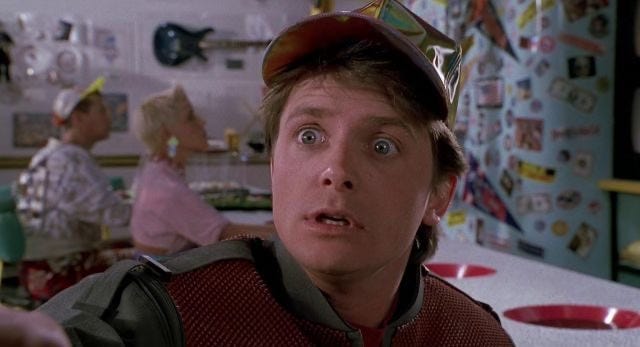
Recently I had a generative conversation with a friend who’s engaged at the emergence of AI at a high level with my mind spinning like a hamster running on a wheel. Our conversation explored the nature of making and photography’s unique perspective on a transformative and disruptive technology. I later considered that the nature, or definition, of what a photograph/er will expand if AI technology continues to develop.
As the concepts and questions continue to turn over in my mind from that conversation I find myself feeling a bit like Marty McFly at the end of the first Back to the Future movie.
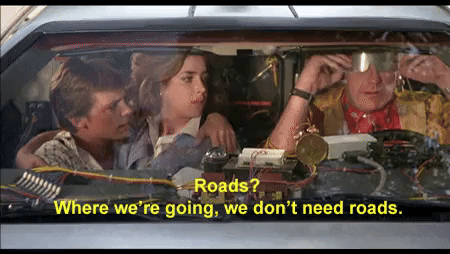
As in the movie, the end is always the start of the next beginning. This cut scene in BTTF 1 is the start of the story in BTTF 2. The beginning also reflects where we’ve just emerged from, as well, as it did for Marty McFly. I’ve lived through several of these cycles myself with photography alone.
Photography was (supposedly) the end of painting. Then, 35mm photography was (supposedly) the end of large and medium format Daguerrotypes. The invention of color photography was (supposedly) the end of black and white. And the invention of digital photography was (say it with me! supposedly) the end of film altogether. None of these proved true over time.
We see that today: How do we explain the rapid increase of film stocks and film sales in the last six years?
This brings me to one of my favorite rhizomatic life -ism’s: two things can be true at the same time.
BTTF 2 runs concurrently with the storyline of BTTF 1. Marty keeps moving between time and story lines in this film. The “bad” timeline in BTTF 2 where Biff Tannen is a business tycoon married to Marty’s mother is seen as an aberration of the “correct” time line in the film.1 It’s not that the “correct” time line has vanished. Rather, in the film, they’re running at the same time.
Circling back to photography, this can mean that the shape of photography will change in the future if AI continues to develop — and within our lifetimes if the current pace of development remains or increases. And, there’s a reason humans continue to be beckoned back to the old ways of making while having cheap and easy access to unprecedented AI creative tools.
Those reasons are more than nostalgia. Humans eventually crave the permanence of the handmade. We engage differently neurologically with screens than we do with something more analog — like painting, film photography, screen printing, etc. The movements of the body producing the work form us internally in ways that screen mediated creation does not.
I experienced this first hand while creating my MFA thesis project, Portraits on Estrangement. I decided to create a body of work with 4x5 film primarily for its limiting factors. Working with large format film is slow, time consuming, and a lot more work than using any of my digital cameras. That increased work was the point. It forced me to be more attuned with my subjects. I made a limited number of exposures during each 1-hour portrait session. The work I made in this series is undoubtedly different than it would have been if I made the work with a digital camera. I am different as an artist for having made it the slower harder way.
Film photography, and analog making, are not going away. They’re making a comeback. All this is happening at the same time, and perhaps because, of AI technology’s rapid development.
Who I want to be on the other side of the new photography is someone who’s not afraid of AI ruining photography. That won’t happen. It will change photography and other forms of creative expression. I want to stay plugged in to how working with each form, or medium, of photography shapes me as an artist and as a human being.
I’m not interested in running from AI. I’m interested in asking unflinching questions about its utility, impact on human working, copyright consumption, and environmental impact. That’s where the both / and — two true things at once — returns to this conversation.
As Marshal McLuhan said: “The medium is the message.” The shape of the making carries weight crucial to understanding the content’s message/idea/narrative. I want to embrace enough curiosity to discover how I am also shaped by whatever tool I use in my making.
Maybe then one day when Doc Brown shows up at my house in a modified DeLorean I’ll be curious enough to go for the ride.
Yes, the year of our Lord 2026 also feels to me like an alternate reality for more reasons than AI.
An incredible read and insight! I'm glad you write!!! : )