
What Seminary Taught Me about Visual Literacy
TLDR: it was ALOT

Many evangelical seminarians walk in with deeply rose colored glasses about their understanding of Scripture, like I did. However, students are exposed to ideas outside of their church experiences, such as: the Proverbs aren’t literal promises God has made humanity (they’re suggestions for wise living written by King Solomon to the people of his day); seminarians also learn that the Book of Revelation isn’t literal end times prophecy (it’s ancient apocalyptic text, a historically more common genre that initial hearers of John’s words would have understood in a completely different context than modern readers of the Left Behind books). These examples are a few of the things I learned in my New Testament class alone. I’ll save the rest for other essays.
My flabbers were ghasted as these little tid bits of common seminary knowledge flowed in and through my learning experience. I felt shell shocked learning these things: If this was all so true how had I never heard it before? I’d attended evangelical churches my entire life. I’d finally had enough one day when a professor told us the whole Revelation thing. I raised my hand and did the only thing my brain seems to comprehend in moments like these — I asked a question.
“If we know all this then why isn’t it preached in church?”
Hold my iced coffee and I’ll tell you what he shared.
This blessing of a human who changed my life for the better said (in my heavily paraphrased version): because either the pastor was a personality hire and never learned these things, or the pastor doesn’t know how to present it in a way that the congregation can handle it.
TLDR: most people aren’t biblically literate (or spiritually mature) enough to handle it.
I was livid, not at my professor, but of the blatant infantilization of maybe millions of evangelical church attending Christian’s who’d been robbed of knowledge because someone else didn’t think these adults en masse could handle it. I wondered: Isn’t the church’s job to help people become spiritually mature enough to handle complex information? It turns out, yes, that is Christ’s call. But in a church assembled in a capitalist system where the pastors and staff are reliant on the tithes of the people attending the church, truth telling has financial consequences. And as my dad used to say, “It’s better to go along to get along.” Or, as my pastor of the church experience that sent me raging into seminary: “Don’t rock the boat.”
I believe most evangelical pastors are well-meaning and want their families fed and their congregations spiritually nourished. There are others however that also like shiny things and expensive footwear. But in my years as a kid church brat, and then as a staff member married to someone in a pastoral role, I saw how the sausage gets made. Even well meaning pastors are pushed up against a wall between making their building rent payments with declining tithes if they say too many uncomfortable truths from the pulpit.
And yet there must be a limit to how far a system goes to ensure attendance is up and tithes are in the black. Jesus doesn’t tell his followers to fill stadiums. He tells them the road to life is narrow (Matt. 7:14).
Years after seminary, and a Master in Fine Arts, I started teaching art classes at a few universities. When I started at one school I was offered an option of what I wanted to teach: a Fine Art Photography class or a History of Photography class. My no hesitation jump on the history class was pure instinct.
As I prepared the class I looked for a structure to help me achieve one of the learning outcomes in the syllabus: visual literacy. In the meantime I built my slides with various historically important figures and photographers. I came across Samuel J. Miller’s portrait of Frederick Douglass.1
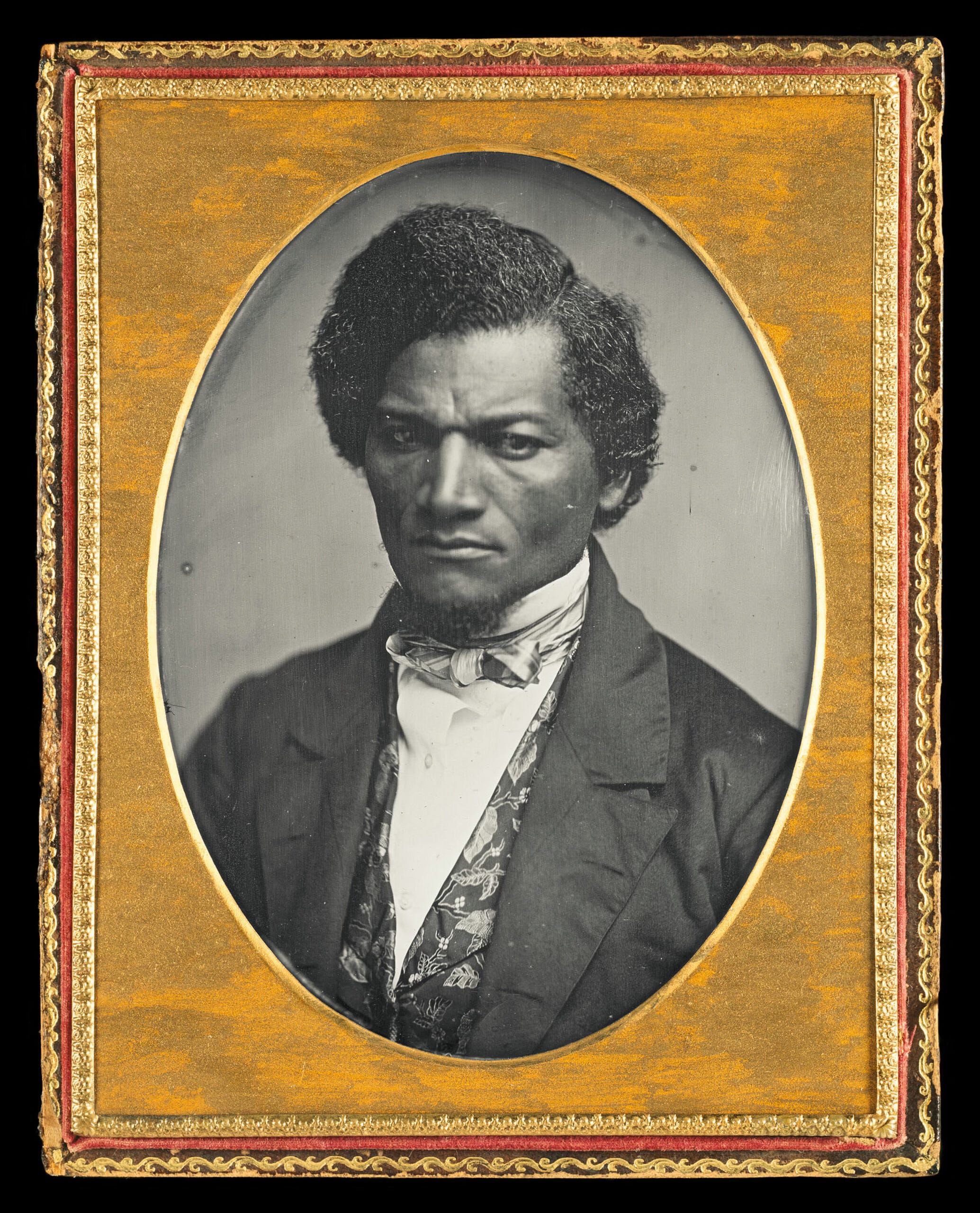
Douglass understood the power of photography before a lot of people did. As an anti-slavery advocate, writer, orator, and activist he had his portrait made 160 times. In a day where most people had none due to the cost and inaccessibility of the technology, this is particularly remarkable.
Douglass distributed his images along side his words. In this powerful but simple choice he showed people who may have never seen a free black person the dignity, power, and humanity inherent in all black people. Douglass used the power of the technology of the photograph to illustrate in an accessible manner to a large number of people that all humans contain the Imago Dei.2 Power under restraint.
His portraits, made throughout his lifetime, are striking. Consistently across them he wears fine clothes, a bold stare, and a serious countenance.3 His portraits display that all humans possess the image of God and are equally human; a powerful counter-claim to those advocating for slavery on the basis of eugenics.4
When I began thinking about how to teach Douglass’ photographic impact, the concept of the 4-Questions of Power came to me:
Who is the photographer?
Who’s in the photograph?
How did the photograph come to be?
Where did the money flow?
These four simple questions unlock our ability to read the images and gather their context, historically and culturally, before we assess them. As I tell my students, we must first understand what the photographs are trying to say before we can form an opinion based on what we like or do not like about them. We must understand before we can assess. This is exactly what my New Testament professor taught me about reading Scripture: we must first understand what it meant to the original audience before we can begin to sort out any possible application it may hold for Christians today. What was happening in the world at the time it was written, who it was being written to, and how influence impacted what was written are all critical pieces of being biblically literate.
What many churches today preach, whether they’re directly aware of it or not, is akin to my teaching only the formal aspects of any photograph. Stating that simply Douglass’ portraits are technically beautiful and powerful with his direct gaze is only the top layer of meaning. Understanding historically what was happening in his lifetime, alongside of how photography was emerging, are critical pieces of information my students need to become visually literate. Similarly, our churches need to take the risk and teach a fuller biblical literacy that includes the pieces without easy or neat answers. That may invite other difficult changes, like changing the financial systems many evangelical churches use today.
We need to challenge ourselves spiritually and trust that God is calling us through the narrow path to something better on the other side.
Henry Louis Gates Jr., “Frederick Douglass’s Camera Obscura,” Aperture Summer 2016, https://archive.aperture.org/article/2016/2/2/frederick-douglasss-camera-obscura.
Latin for: Image of God.
Some of this neutrality of Douglass’ expression can be attributed to the limits of photographic technology of the day, due to the length of minutes a person having their portrait made would have to remain completely frozen.
For an example of the presence of eugenics in photography, see: https://smarthistory.org/images-in-a-divided-world/